China & the USA by Vassilis K. Fouskas & Shampa Roy-Mukherjee & Qingan Huang & Ejike Udeogu
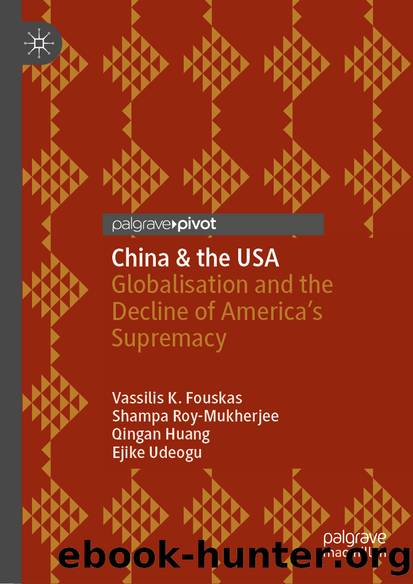
Author:Vassilis K. Fouskas & Shampa Roy-Mukherjee & Qingan Huang & Ejike Udeogu
Language: eng
Format: epub
ISBN: 9783030610975
Publisher: Springer International Publishing
Having said that, China is not primarily responsible for the slow and protracted decline of the manufacturing base of Anglo-Saxon economies.1 If anything, as we shall see below, China and other economiesâespecially petro-states, such as Saudi Arabiaâhelp sustain the value of the dollar and the low interest rates regime of the American Fed. Rather, the primary responsibility for the decline of the West lies with the policy of their corporate financial and political elites, a bi-partisan consensus between the parties of the Left and the Right initiated in the 1980s and established the 1990s, especially after the failure of Francois Mitterrandâs Keynesian experiment in France in 1981â1983, followed by the transformation of the Italian Communist Party into a âThird Wayâ neo-revisionist formation.2 These parties, usually of social democratic and centrist stock, having embraced neo-liberalism and ordoliberalism, offer abundant opportunities to xenophobic and racist parties to flourish as they are unable, or do not want, to grasp the actual causes of the crisis that have engulfed their neo-liberal regimes since 2007â2008 and which has been further exacerbated by Covid-19. It is true, however, that China has since its entry in the WTO (2001) been amassing a sustained push towards global primacy at a moment when the Anglo-American core is rather unwilling to change policy direction, whereas the EU/Eurozone is essentially left without policy instruments of recovery from its multiple crises, including the havoc caused by the pandemic. Overall, the corporate financial and political elites of the transatlantic core seem to have no strategic orientation as to where they want to see their political economies going, since socialism is, obviously, off the table.
Footnotes
1This view transpires in Justin Rosenberg and Chris Boyle (2019), op.cit. On the basis of the evidence we gathered, we would suggest that China enters the competitive constraint of UCD mechanism in full in the 1990s, and definitely after its entry in WTO in 2001. Thus, the Rosenberg-Boyle thesis on the erosion of USA manufacturing basis due to outsourcing to China and Asia stands up, but after the 1990s.
Download
This site does not store any files on its server. We only index and link to content provided by other sites. Please contact the content providers to delete copyright contents if any and email us, we'll remove relevant links or contents immediately.
| Anthropology | Archaeology |
| Philosophy | Politics & Government |
| Social Sciences | Sociology |
| Women's Studies |
The Secret History by Donna Tartt(19362)
The Social Justice Warrior Handbook by Lisa De Pasquale(12259)
Thirteen Reasons Why by Jay Asher(9047)
This Is How You Lose Her by Junot Diaz(6999)
Weapons of Math Destruction by Cathy O'Neil(6402)
Zero to One by Peter Thiel(5896)
Beartown by Fredrik Backman(5873)
The Myth of the Strong Leader by Archie Brown(5578)
The Fire Next Time by James Baldwin(5540)
How Democracies Die by Steven Levitsky & Daniel Ziblatt(5293)
Promise Me, Dad by Joe Biden(5206)
Stone's Rules by Roger Stone(5150)
A Higher Loyalty: Truth, Lies, and Leadership by James Comey(5032)
100 Deadly Skills by Clint Emerson(4991)
Rise and Kill First by Ronen Bergman(4861)
Secrecy World by Jake Bernstein(4822)
The David Icke Guide to the Global Conspiracy (and how to end it) by David Icke(4791)
The Doomsday Machine by Daniel Ellsberg(4581)
The Farm by Tom Rob Smith(4573)
